
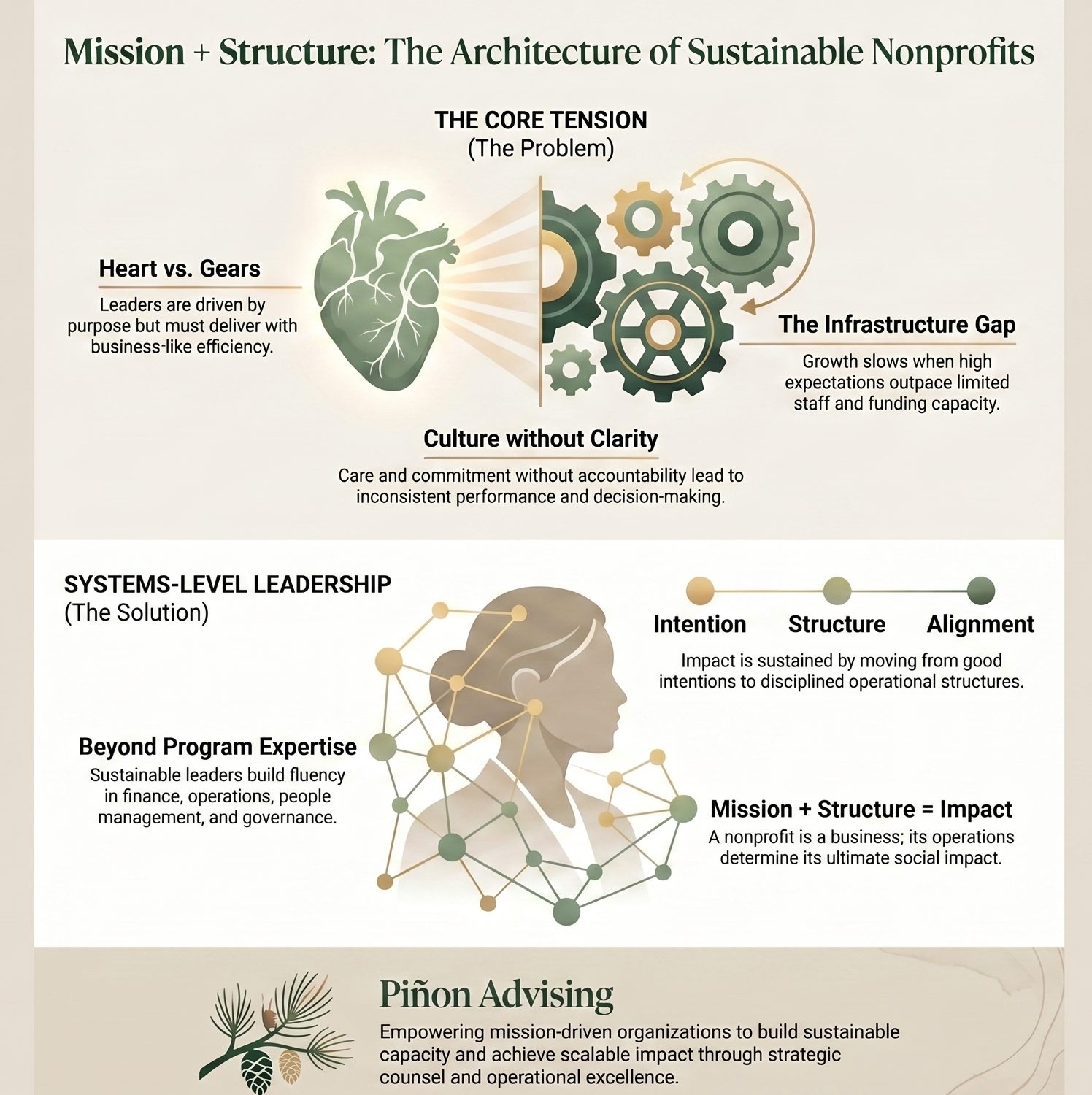
There’s a tension in nonprofit leadership that doesn’t get talked about enough.
Leaders are expected to be deeply mission-driven. Grounded in purpose. Connected to community. That’s what draws people to this work, and it’s what sustains it.
At the same time, leaders are expected to operate with the discipline, clarity, and performance of a business. Manage budgets. Build systems. Deliver outcomes. Make hard decisions that don’t always feel aligned with the spirit of the work, but are necessary to sustain it.
Both expectations are real. And both matter.
But they don’t always sit easily together.
In practice, this tension shows up in ways that are often misunderstood.
Work slows down or stalls, not because people don’t care, but because direction isn’t clear or consistent.
Teams struggle to execute, not because they lack commitment, but because the systems needed to support the work were never fully built.
Leaders find themselves carrying everything, vision, operations, relationships, and stability, often with limited staff and limited funding, inside structures that were never designed to support that level of complexity.
And layered into this is something even more challenging.
Most leaders in this sector inherit systems they didn’t build.
They step into organizations with existing cultures, processes, and expectations, and are asked to move the work forward without always having the space, resources, or alignment to rebuild what isn’t working.
At the same time, many organizations lean heavily on a culture of care and commitment. That matters. It’s a strength of this sector.
But when care is not paired with clarity and accountability, it can start to erode the very outcomes it’s meant to support.
Expectations become inconsistent. Decision-making becomes unclear. Performance becomes difficult to manage. And growth slows, even when the intent is to do the opposite.
This is not a failure of mission. It’s a gap in how we lead within it.
Because the sector doesn’t just need people who are moved by the work.
It needs leaders who can think at a systems level.
Who can move between strategy and execution.
Who can operate as both specialists in their mission and generalists in how organizations function.
Leaders who can see the full picture—not just the program, but the structure that holds it.
This is the shift.
And it’s a shift that can be learned.
It starts with expanding how we see our role.
Not just as stewards of mission, but as designers of systems.
It requires building fluency across areas that may not have been part of why we entered this work. Finance. Operations. People management. Governance. Understanding how decisions in one area affect the whole.
It means asking different questions.
Not just “What does the community need?” but also “What does it take to deliver that consistently, at scale, and over time?”
It means being willing to name what isn’t working, even when it’s uncomfortable. To move from intention to structure. From effort to alignment.
And it means recognizing that running an organization well is not separate from the mission.
It is how the mission becomes real.
This tension doesn’t go away.
But when it’s understood, it changes how we lead.
And when it’s navigated well, it strengthens both the work and the people doing it.
At Piñon Advising, this is the work we step into alongside leaders every day.
Across the nonprofit sector, we partner with organizations to think beyond immediate needs and toward what will actually grow and sustain their work over time. That means strengthening strategy, building the right structures, and aligning resources with reality.
Because a nonprofit is a business.
And when it’s run with that level of clarity and intention, it doesn’t move away from its mission.
It becomes far more capable of delivering on it.