
Architects and Builders
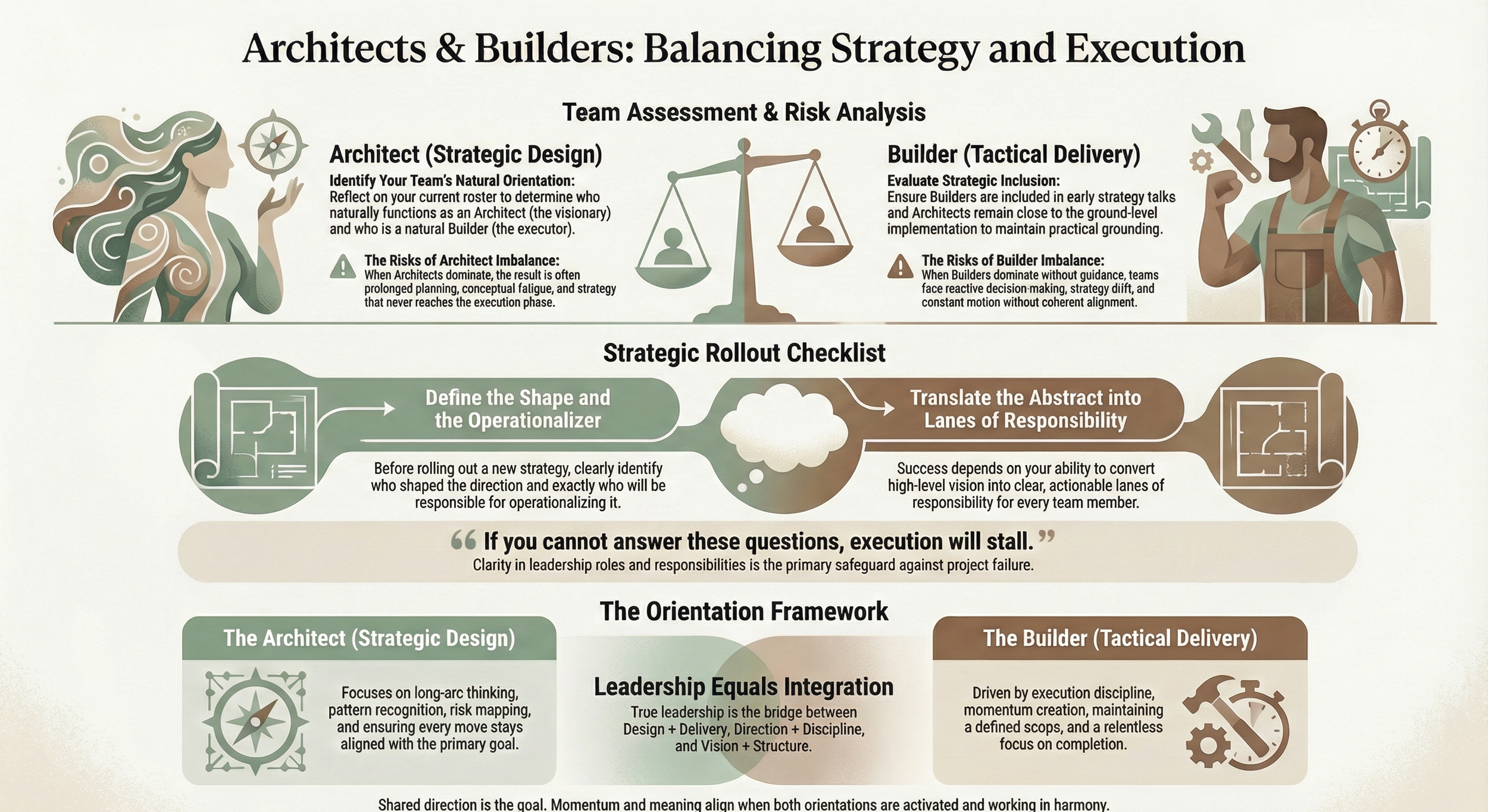
Why Strategic Orientation Is Not Universal and Why That’s a Good Thing
In every organization, there are architects and there are builders.
Architects naturally think in patterns. They see systems, long arcs, downstream impact. They anticipate what a decision today will mean two years from now. They are energized by ambiguity because they are mapping the future.
Builders think in movement. They want clarity, direction, tangible progress. They solve the immediate problem in front of them. They measure success by what gets completed.
Both are essential.
The tension begins when we assume everyone is wired the same way.
What Architects Do
Architects connect dots others do not immediately see.
They ask questions that stretch timelines.
They resist decisions that move fast but compromise direction.
They think about risk, positioning, sustainability, and alignment.
Their strength is coherence.
Their risk is distance from day-to-day reality.
Without builders, architects design beautiful plans that never materialize.
What Builders Do
Builders create momentum.
They operationalize ideas.
They execute with discipline.
They value clarity, timelines, and defined scope.
Their strength is movement.
Their risk is narrowing the lens to only what is directly in front of them.
Without architects, builders can move quickly in the wrong direction.
The Leadership Mistake
Leaders often make one of two errors.
They assume everyone should think strategically and become frustrated when staff do not see the big picture.
Or they reward execution alone and dismiss long-range thinking as overcomplication.
Neither builds durable organizations.
The work of leadership is not to choose one orientation over the other.
It is to align them.
Strategic Thinking Is a Muscle, Not a Rank
Not everyone is naturally future-oriented. That is not a flaw. It is a starting point.
Strategic capacity can be developed, but it requires exposure and intentional practice. If staff are never invited into the context behind decisions, they will default to task orientation. That is predictable, not problematic.
Leaders must translate vision into operational clarity.
They must also elevate builders into broader awareness.
That looks like:
Explaining not just what is changing, but why.
Mapping second- and third-order impacts out loud.
Inviting execution-focused staff into early conversations.
Showing how today’s task connects to enterprise direction.
Just as important, strategic leaders must stay close enough to operations to remain credible.
How This Shows Up in Leadership Delivery
Strategy is often abstract.
It lives in direction, positioning, long-term design, cultural shifts, systems change. For architects, that abstraction feels energizing. For builders, it can feel unclear, even destabilizing.
If we are one team, leadership cannot leave strategy floating in the air.
Leaders must translate.
That translation requires discipline.
Convert abstraction into defined lanes
When direction is set, the next question is not whether everyone agrees.
It is what this means for each role.
Architects may be comfortable with a 12-month vision.
Builders need to know:
What changes this week.
What changes this quarter.
What does not change.
What I am now responsible for.
If leaders do not define lanes, task-oriented staff will create their own. That is when fragmentation begins.
Design work so both orientations are activated
One team does not mean one way of thinking.
In practice, this means inviting architects to shape frameworks, sequencing, risk mapping, and external alignment.
It also means inviting builders to stress-test timelines, identify operational gaps, and design implementation plans.
Strategy without implementation input is theoretical.
Implementation without strategy is reactive.
When both are engaged early, delivery strengthens.
Make contribution visible
Builders need to see progress. Architects need to see alignment.
Leaders should regularly articulate:
Here is the long-term direction.
Here is what we completed this month that advances it.
Here is what we learned that may refine it.
This reinforces that daily work is not disconnected from design. It is the mechanism through which design becomes real.
The Role of the Leader
The leader becomes the integrator.
You hold the long arc while structuring near-term clarity.
You protect strategic focus while honoring operational realities.
You prevent abstraction from becoming elitism and prevent execution from becoming drift.
When delivery includes a role for everyone, something important happens.
Builders feel valued for momentum.
Architects feel valued for direction.
The organization feels coordinated.
High-performing organizations do not consist solely of strategists.
They consist of people who understand how their work fits inside strategy.
Architects need builders to make ideas real.
Builders need architects to ensure effort is aligned.
The goal is not to turn every builder into an architect.
The goal is shared direction.
When that happens, the organization stops operating in fragments and starts operating with design.
Momentum and meaning align.
That is leadership.